White Paper
3 November 2026
Estimated reading time: 10 min
Mapping Sweden’s BESS Market through its Largest Projects
Key takeaways
- Reserve markets are crowded. Prequalified batteries passed the demand cap for Frequency Containment Reserve for disturbances (FCR-D) in 2024. About 230 MW more qualified for manual Frequency Restoration Reserve (mFRR) between January and April 2026 alone.
- Revenues swing month to month. Clean Horizon’s Swedish two-hour benchmark fell about 20% to €126,000 per MW per year in July 2026. It recovered to €138,000 in August.
- Stacking markets pays. In Flower’s early 2025 modeling, combining reserve products lifted revenue 23% over a single product. Adding day-ahead trading added another 17%.
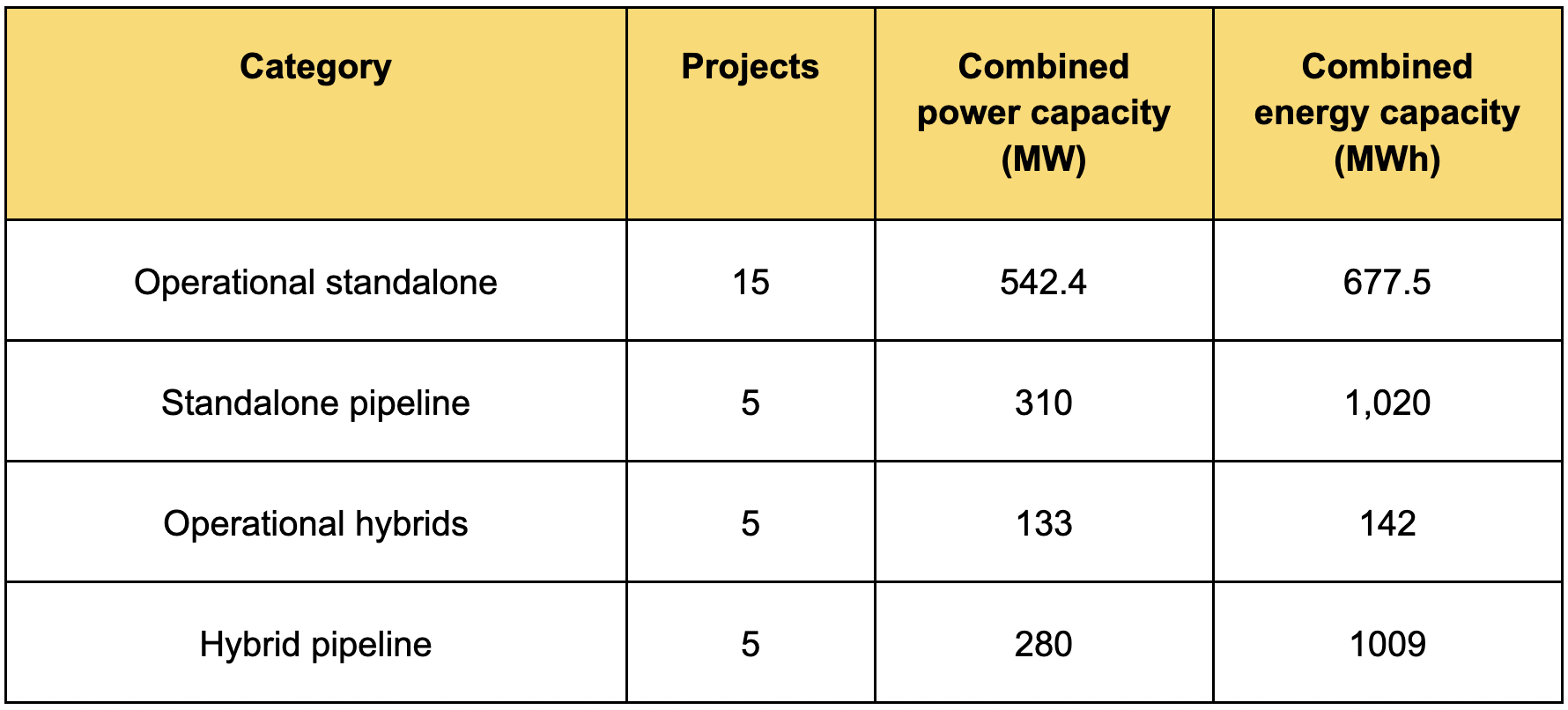
- The pipeline is going longer. Eleven of the fifteen largest operational standalone BESS hold one hour of storage. The five largest standalone pipeline projects pair 310 MW with 1020 MWh, led by Vaggeryd’s four-hour 100 MW / 400 MWh design.
- Location and grid access decide the business case. Arbitrage spreads are strongest in southern zones SE3 and SE4, and grid fees reduce gross spreads. On 1 October 2026, 2260 MW of storage was waiting in Svenska kraftnät’s transmission connection queue.
Introduction
Sweden’s battery energy storage system (BESS) market grew rapidly through frequency reserve services.¹,² RaboResearch’s July 2026 overview indicates approximately 750 MW of operational capacity and a further 1.6 GW under construction, permitted, or announced.¹⁵ As more batteries compete for reserve contracts, pressure on prices is prompting operators to broaden their market participation.¹ Recent projects illustrate this shift. Ånge’s newly commissioned 70 MW / 160 MWh system trades across wholesale and ancillary service markets, while Vaggeryd’s planned 100 MW / 400 MWh design provides four hours of storage.³,⁴
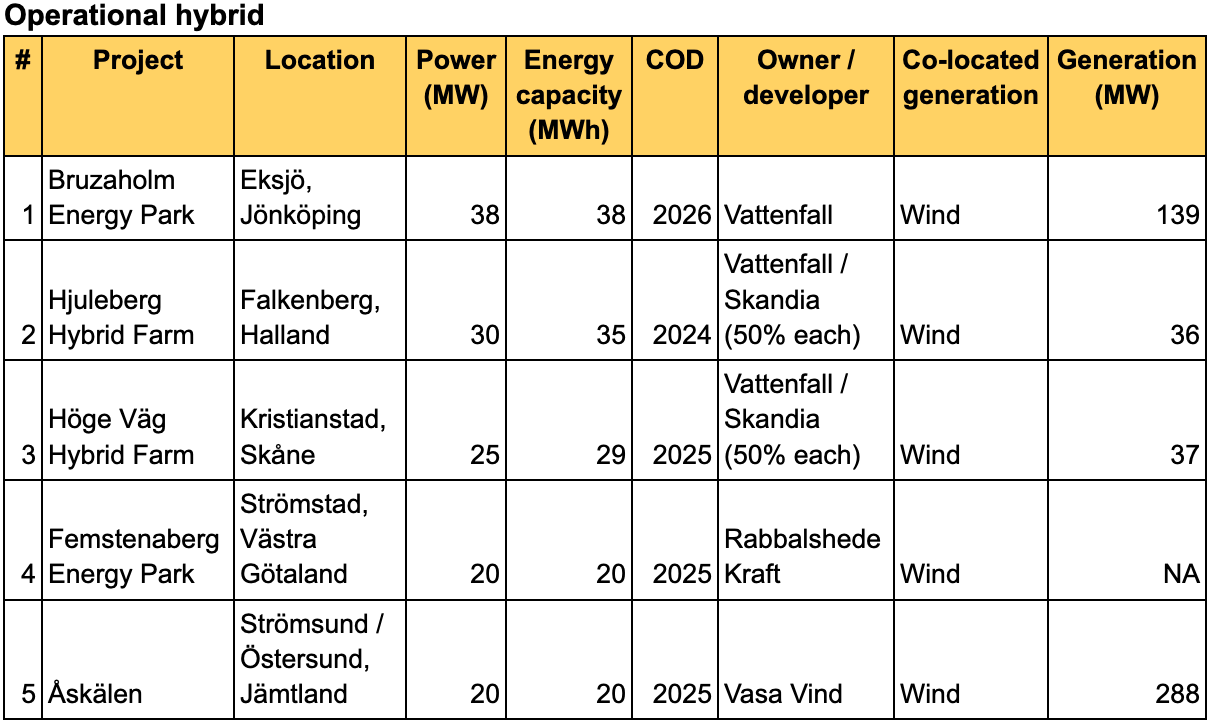
This report follows that shift across 30 projects ranked by energy capacity, covering 15 operational standalone sites and the top five in each of the standalone pipeline, operational hybrid, and hybrid pipeline categories. The operating projects total approximately 675 MW, close in scale to RaboResearch’s published fleet estimate, while the selected pipeline projects total 590 MW, equivalent to more than a third of its reported pipeline. These comparisons indicate scale rather than exact market shares, given the different reporting dates. Each list connects projects to the conditions shaping their revenues and delivery, from reserve competition and wholesale trading to generation management and grid access.
Standalone batteries and reserve competition
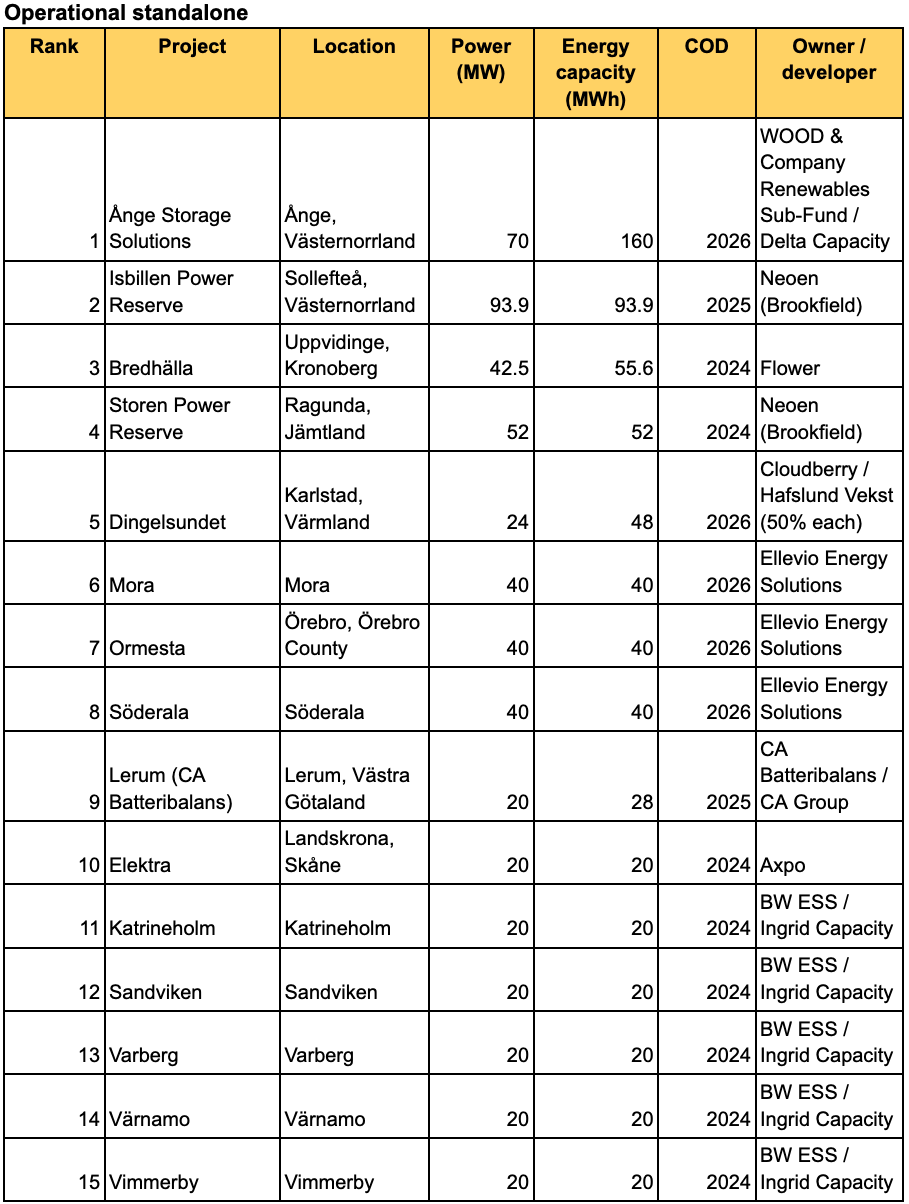
Sweden’s early emphasis on frequency reserves is still visible in its operating fleet. Eleven of the fifteen standalone projects listed below have one hour of storage, including Isbillen’s 93.9 MW system, the largest operational BESS project by power output.⁶ Yet the market has changed. Flower identifies visible saturation in Frequency Containment Reserve for disturbances (FCR D) from 2024, as more batteries qualified to compete for reserve contracts.¹,² Ånge’s wholesale and ancillary service agreement illustrates how operators can widen their options, as that competition puts pressure on prices.⁴
The same pressure has reached manual Frequency Restoration Reserve (mFRR). Flower reported about 230 MW of additional prequalified battery capacity between January and April 2026, a 20% increase, while procurement volumes grew more gradually.² These figures measure eligibility to provide a service, rather than actual dispatch.
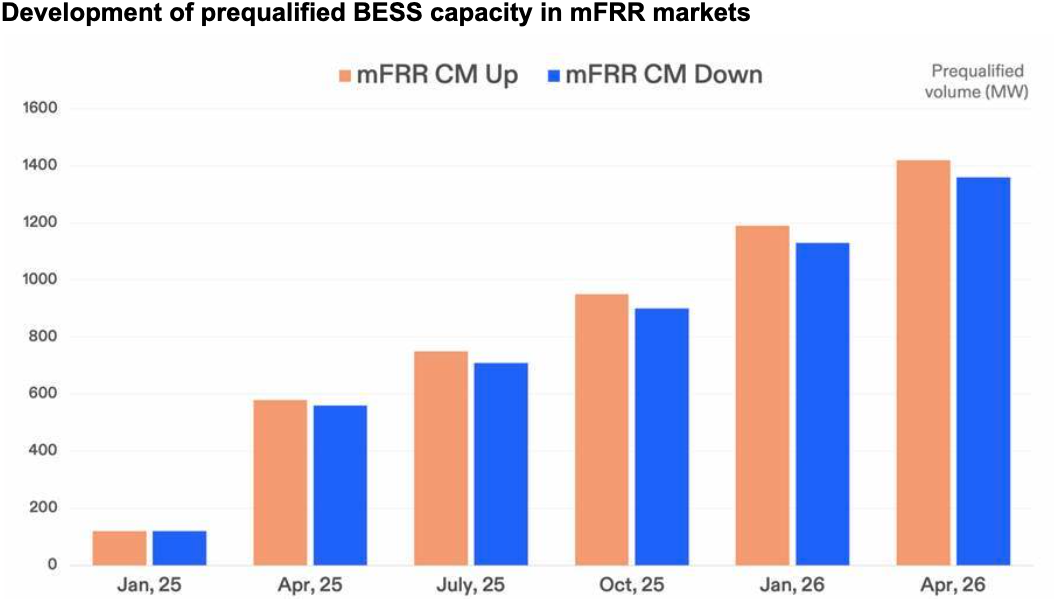
Source: Flower
Reserve prices have changed as more batteries entered these markets. Several reserve products have fallen from the higher levels seen in 2022 and 2023, while their price paths have diverged.² An operating strategy therefore needs to respond to the relative value of each product.
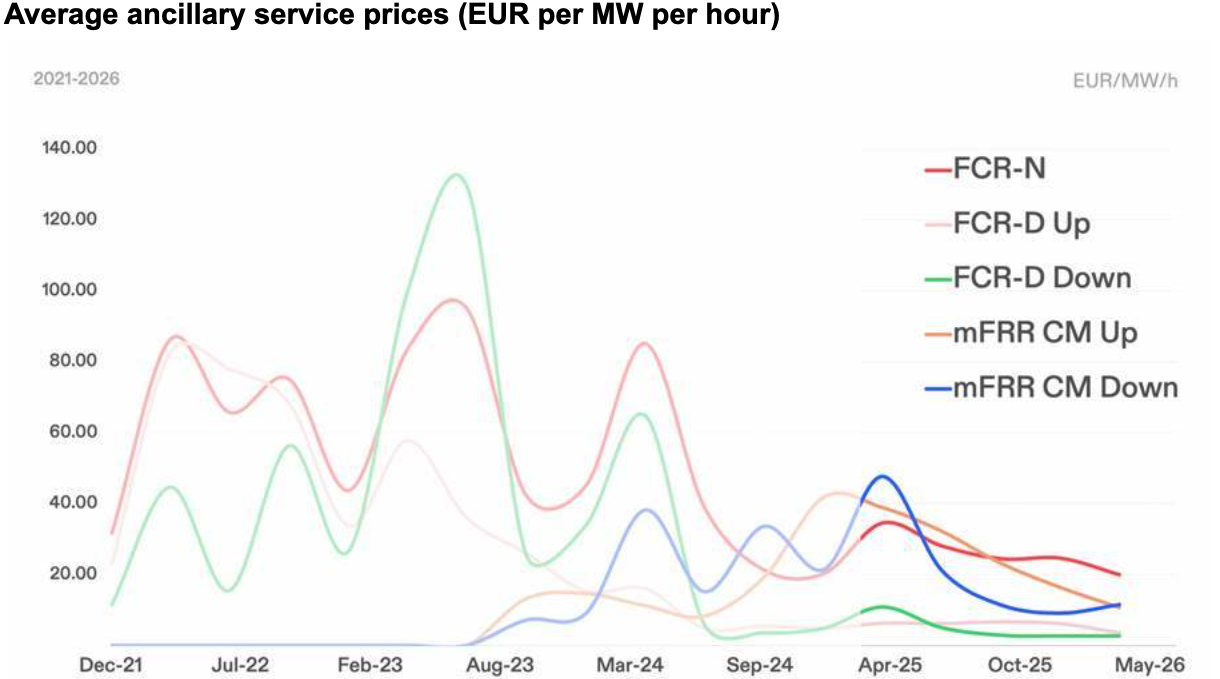
Source: Flower
The revenue impact can be abrupt. In July 2026, weaker FCR and mFRR capacity prices cut Clean Horizon’s Swedish two-hour benchmark by about 20% to €126000 per MW per year.⁷ In August, prices recovered to €138000 as ancillary prices strengthened and day-ahead spreads widened.⁸ These swings show why an investment case built on one month’s prices can quickly lose relevance.
The benchmark estimates what a model battery could earn in each month, expressed at an annual rate.⁹ It measures revenue before grid fees, taxes, and the costs of maintaining the battery’s charge level, assuming 85% round-trip efficiency, 1.5 cycles per day, and full availability.⁹ A January 2026 methodology change also limits comparison with earlier data.⁹ Actual project cash flow depends on the asset’s costs and operating limits.
Allocation across reserve and energy markets
Lower reserve prices encourage operators to reassess how their batteries earn revenue. Flower attributed stronger optimization revenues in the fourth quarter of 2025 partly to allocating more capacity to mFRR.¹⁰ Its platform allocates capacity between reserve services and buying and selling electricity in wholesale markets, based on expected returns.¹⁰ Access to several markets allows operators to adjust this revenue mix as prices change.
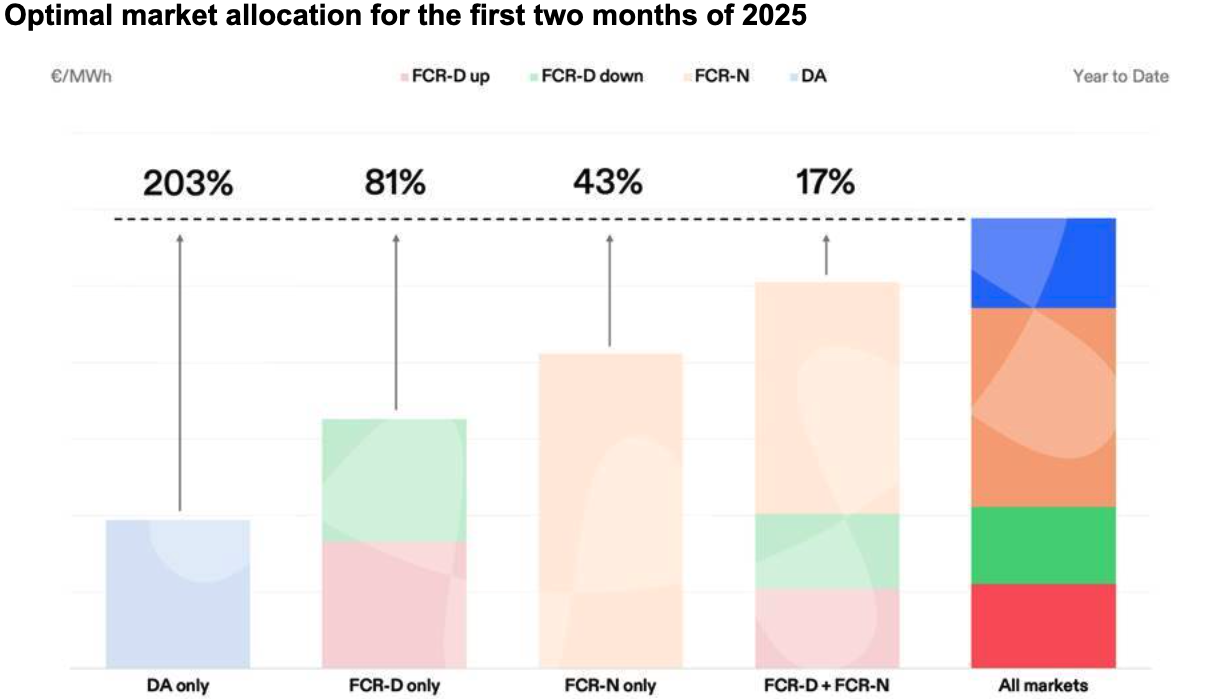
For one unnamed battery on a day in January 2025, Flower reported 70% of revenue from day-ahead trading and total revenue 118% above an FCR D-only strategy.¹ This was a day with substantial arbitrage opportunities, rather than a representative annual mix.
Flower’s early March 2025 study compared how different trading strategies would have performed using prices from the start of the year.¹ Combining FCR N and FCR D raised modeled revenue by 23% over FCR N alone, and adding day-ahead trading delivered a further 17% gain.¹ The chart below shows the relative value of choosing a market mix as opportunities change.
Source: Flower
Capturing these opportunities also requires trading and control systems that can follow shorter market periods.
Market rules and project operation
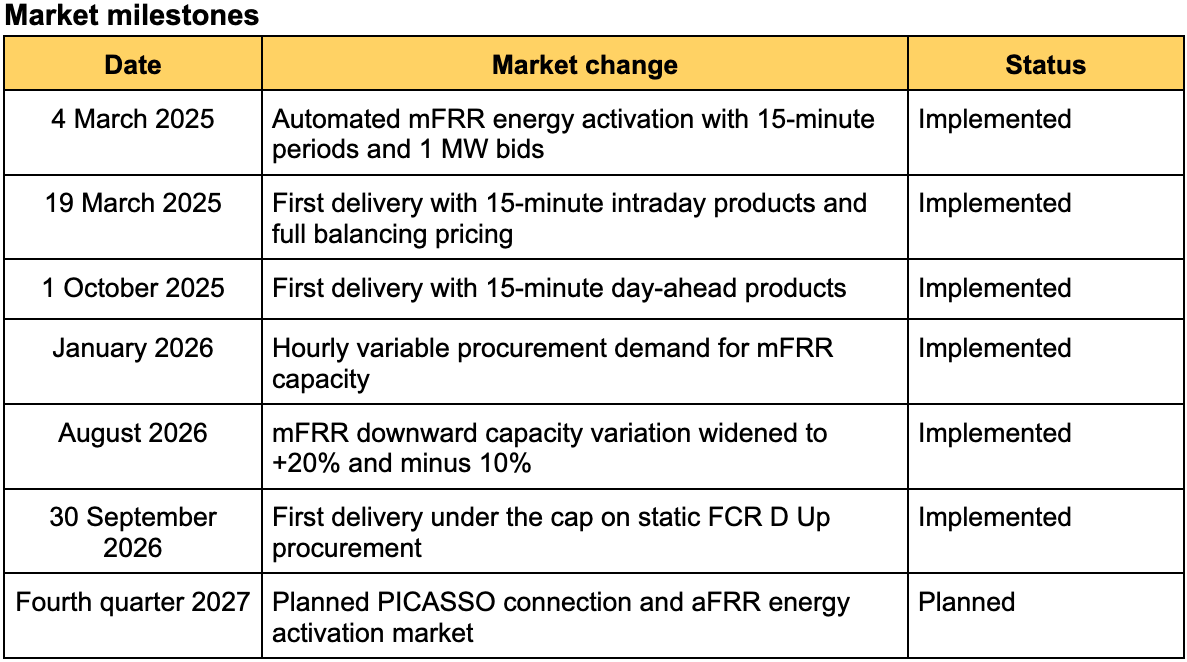
Automated mFRR energy activation began on 4 March 2025, with 15-minute periods and 1 MW bids.¹¹ Intraday delivery and full quarter-hour balancing pricing followed from 19 March, and day-ahead delivery moved to 15-minute periods from 1 October.¹²,¹³
Standalone pipeline and wholesale trading
Vaggeryd’s revised 100 MW and 400 MWh plan provides four hours, while Horsaryd’s 100 MW and 200 MWh design provides two at rated power.⁵ Both target full operation in 2028, with Vaggeryd’s expanded specification requiring an updated permit.⁵ These designs extend dispatch, with additional investment needed in energy capacity.
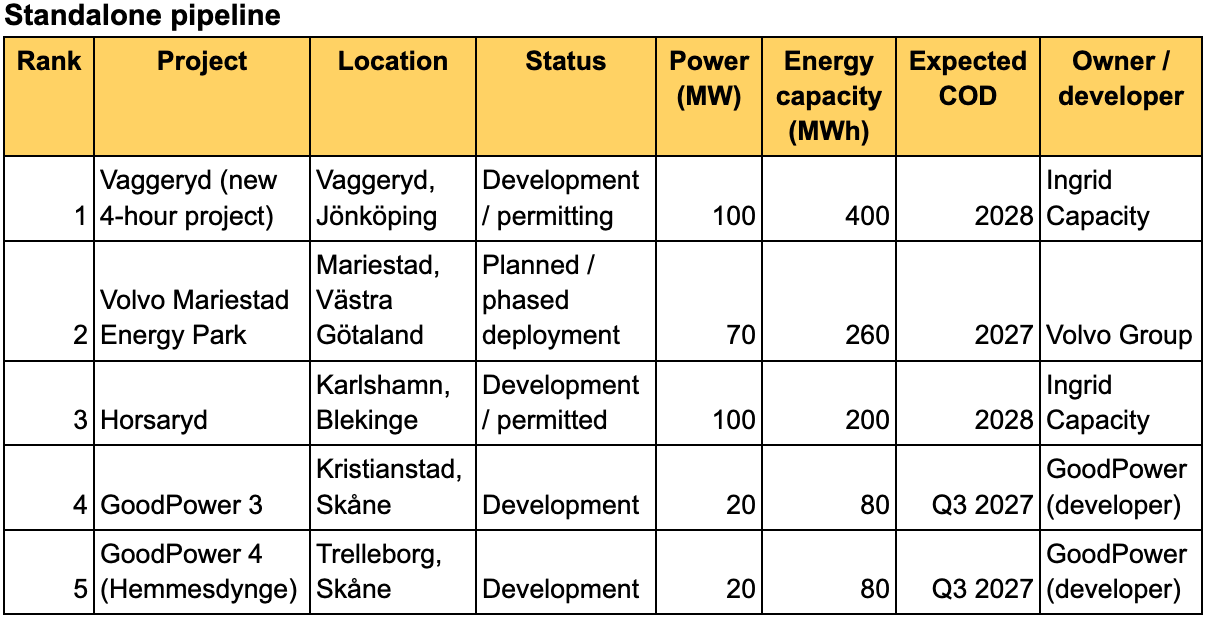
Volvo’s 70 MW Mariestad energy park will deploy batteries in phases, starting with ten units in the first quarter of 2027.¹⁴ Planned capacity therefore needs to be distinguished from the first delivery stage.
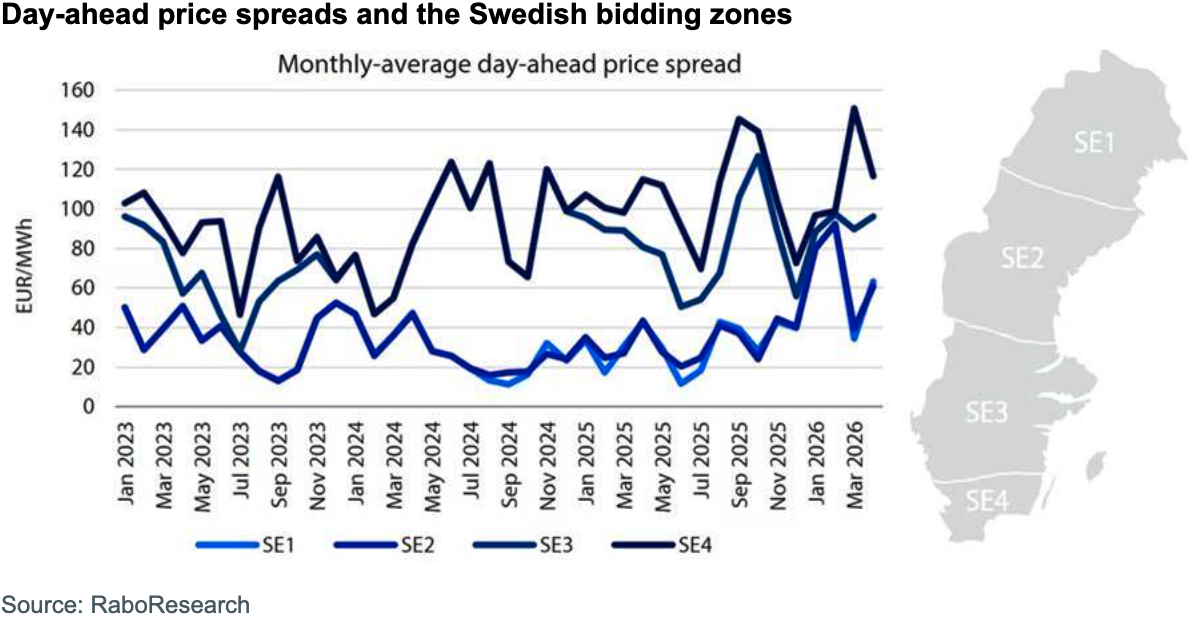
Wholesale arbitrage revenue opportunities vary by location. RaboResearch identifies stronger arbitrage spreads in southern zones SE3 and SE4.¹⁵ Hydropower and lower electricity demand limit arbitrage in northern zones SE1 and SE2, where ancillary services have greater relative importance.¹⁵ A battery’s intended market strategy must fit its bidding zone.
Hybrid projects and generation management
Hybrid operation links storage decisions to wind or solar output. Femstenaberg’s 20 MW / 20 MWh battery supports wind park optimization and reserve services.¹⁶ At Hjuleberg, Vattenfall controls wind turbines and storage as one unit, updating combined output in real time.¹⁷ The battery can store energy when wind output needs to be reduced and deliver it later, while market bids account for plant status and grid limits.¹⁷ The optimizer therefore chooses when to export generation and how much capacity to offer in reserve markets.
Grid fees reduce the net revenue a battery earns from electricity trading. Charging from the grid and discharging into it can both incur fees in Sweden.¹⁵ RaboResearch describes a capacity charge and a component linked to network losses, with costs varying by location.¹⁵ These charges absorb part of the gross arbitrage spread. Expected cash flow must therefore account for the connection agreement and tariff, as well as buying and selling prices.
Grid access and delivery
A project’s proposed capacity only becomes commercially useful once it can connect. On 1 October 2026, Svenska kraftnät’s queue included 2260 MW of requested storage injection and 2176 MW of withdrawal awaiting capacity reservation and a preliminary decision.¹⁸ A battery can appear on both sides of the queue because it needs grid access to charge and discharge. The figures point to substantial developer interest, but delivery depends on securing that access and completing the connection.
Dingelsundet shows why existing infrastructure can be valuable. Hafslund describes the battery’s use of a substation originally intended for a wind project in Vänern.¹⁹ Smedjebacken’s secured connection provides another reason to track grid readiness alongside planned energy capacity.²⁰
The hybrid pipeline applies that combination at greater scale. Smedjebacken pairs 150 MW of solar with a proposed 150 MW and 600 MWh battery, while Fageråsen combines wind generation with 50 MW and 209 MWh of storage.²⁰,²¹ Their designs provide around four hours at rated power, extending the energy shifting possibilities beyond the currently mainly one-hour operating hybrid selection.
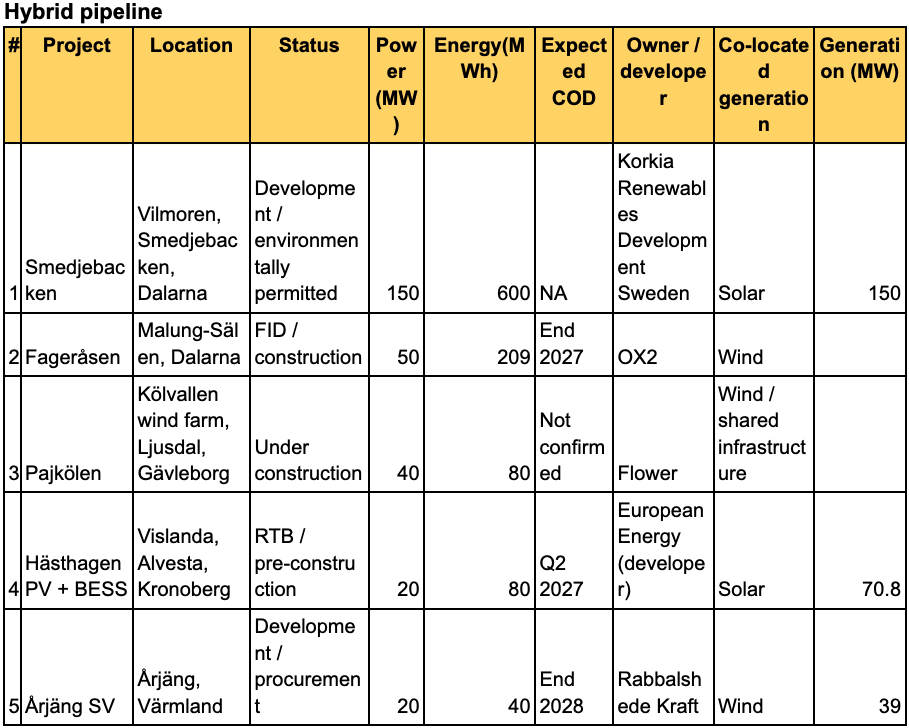
Permits, grid access and investment decisions provide a clearer picture of when pipeline capacity could enter the market. Smedjebacken has secured an environmental permit and a grid connection.²⁰ Fageråsen reached final investment decision in July 2026.²¹ Flower reported Pajkölen as under construction in its second-quarter report.²² These milestones bring projects closer to operation. Once operating, the value of co-location depends on the site’s grid connection limits and how generation and storage are managed together.
Reserve demand and market access
Securing a connection enables delivery, but reserve revenues also depend on the capacity the system operator needs. Since January 2026, Svenska kraftnät has used weather data and potential failure scenarios to forecast the next day’s mFRR needs and adjust the capacity it buys each hour.²³ The initial range of 10% above or below the static requirement expanded for downward regulation in August to 20% above and 10% below.²³ It can therefore purchase more capacity in hours with higher forecast need and less in hours with lower need.²³
Access to reserve revenues also depends on a battery’s technical classification. Nordic operators capped static FCR D Up resources at 50% of total demand from first delivery on 30 September 2026.²⁴ The restriction applies to resources classified as static according to their control response.²⁴ Owners need to check their qualification category before assuming that all available capacity can compete on the same terms.
The next planned expansion is in automatic Frequency Restoration Reserve (aFRR). Svenska kraftnät intends to connect to the European PICASSO platform and launch an aFRR energy activation market in the fourth quarter of 2027.²⁵ For projects now in development, this creates a prospective revenue route, subject to qualification and the rules at launch.
Conclusion
The lists of operational and pipeline projects show that the operating market faces reserve competition, while the pipeline pursues longer dispatch and greater integration with renewable generation. RaboResearch still expects ancillary services to support one- to two-hour systems in the broader Nordic market.¹⁵ The large projects present in this report therefore illustrate particular development choices. Their ability to earn revenue will depend on matching design and location to market access, as well as progress through permitting and grid connection.
The developments outlined in this paper will be central to the fourth Solarplaza Summit Sweden PV & Storage, taking place in Stockholm on 10 March 2027. The summit will bring together energy experts from every segment of the sector to examine the commercial decisions shaping Sweden’s solar and battery storage projects.
Discussions will focus on BESS offtake structures in a competitive market, trading strategies that respond to power price volatility, and operational case studies comparing actual performance with investment assumptions. Bankability and policy developments will provide further context for project decisions.
Join industry peers in Stockholm to exchange experience and discuss how Sweden’s next generation of PV and storage projects can progress from development to operation.
Sources
¹ Flower (2025) After FCR: Who Takes Pole Position in the New Era of Wholesale Trading? Retrieved from
https://www.flower.se/insights/market-insight/after-fcr-who-takes-pole-position-in-the-new-era-of-wholesale-trading/
² Flower (2026) Why Are Prices in Ancillary Services Markets Falling? Retrieved from
https://www.flower.se/insights/market-insight/why-are-prices-in-ancillary-services-markets-falling/
³ WOOD & Company (2026) WOOD & Company and Delta Capacity complete Nordics' largest battery storage project in 15 months. Retrieved from
https://wood.com/insights/our-company/wood-and-company-and-delta-capacity/
⁴ Centrica (2026) Centrica Energy, Delta Capacity and Wood & Co. Sign Optimisation Agreement for 70 MW / 160 MWh BESS in Sweden. Retrieved from
https://www.centrica.com/media-centre/news/2026/centrica-energy-delta-capacity-and-wood-co-sign-optimisation-agreement-for-70-mw-160-mwh-bess-in-sweden/
⁵ Ingrid Capacity (2026) Ingrid doubles the size of its battery storage portfolio with groundbreaking projects in southern Sweden - surpassing 1 GWh in capacity. Retrieved from
https://www.ingridcapacity.com/news/ingrid-doubles-the-size-of-its-battery-storage-portfolio-with-groundbreaking-projects-in-southern-sweden---surpassing-1-gwh-in-capacity
⁶ Neoen (2026) Isbillen Power Reserve. Retrieved from
https://sweden.neoen.com/sv/projekt/isbillen-power-reserve/
⁷ Clean Horizon (2026) Storage Index: July 2026 is out! Retrieved from
https://www.cleanhorizon.com/news/storage-index-july-2026/
⁸ Clean Horizon (2026) Storage Index: August 2026 is out! Retrieved from
https://www.cleanhorizon.com/news/storage-index-august-2026-is-out/
⁹ Clean Horizon (2026) Storage Index. Retrieved from
https://www.cleanhorizon.com/battery-index/
¹⁰ Flower (2026) Fourth Quarter and Full Year Report 2025. Retrieved from
https://www.flower.se/wp-content/uploads/2026/03/Flower-Fourth-Quarter-and-Full-Year-Report-2025.pdf
¹¹ Svenska kraftnät (2025) 15 minuters balansering av elsystemet är nu permanent. Retrieved from
https://www.svk.se/press-och-nyheter/nyheter/balansansvar/2025/15-minuters-balansering-av-elsystemet-ar-nu-permanent/
¹² Svenska kraftnät (2024) 15 minuters handelsperiod på Intradagsmarknaden för el införs den 18 mars. Retrieved from
https://www.svk.se/press-och-nyheter/nyheter/balansansvar/2024/15-minuters-handelsperiod-pa-intradagsmarknaden-for-el-infors-den-18-mars/
¹³ Svenska kraftnät (2025) 15 minuters handelsperiod på Dagen före-marknaden för el införs 30 september. Retrieved from
https://www.svk.se/press-och-nyheter/nyheter/elmarknad-allmant/2025/15-minuters-handelsperiod-pa-dagen-fore-marknaden-for-el-infors-30-september/
¹⁴ Volvo Energy (2026) Volvo Energy delivers 70MW of Battery Energy Storage (BESS) to the Volvo Group energy park initiative in Mariestad. Retrieved from
https://www.volvoenergy.com/en/news-media/news/2026/sep/volvo-energy-delivers-70mw-of-battery-energy-storage-in-mariestad.html
¹⁵ RaboResearch (2026) Backup power for Europe - part 8: Ranking BESS market attractivity in the Nordics. Retrieved from
https://www.rabobank.com/knowledge/d011535313-backup-power-for-europe-part-8-ranking-bess-market-attractivity-in-the-nordics
¹⁶ Rabbalshede Kraft (n.d.) Femstenaberg. Retrieved from
https://www.rabbalshedekraft.se/en/project/femstenaberg-2
¹⁷ Vattenfall (2024) Hybridteknik ger ny kraft till vind och sol i södra Sverige. Retrieved from
https://group.vattenfall.com/se/nyheter-och-press/nyheter/2024/hybridteknik-ger-ny-kraft-till-vind-och-sol--i-sodra-sverige
¹⁸ Svenska kraftnät (2026) Information om pågående anslutningsärenden. Retrieved from
https://www.svk.se/aktorsportalen/anslut-till-transmissionsnatet/information-om-pagaende-anslutningsarenden/
¹⁹ Hafslund (2025) Hafslund og Cloudberry skal bygge batterilager i Sverige. Retrieved from
https://www.hafslund.no/no/om-oss/presse/hafslund-og-cloudberry-skal-bygge-batterilager-i-sverige
²⁰ Korkia (2026) One of Scandinavia’s largest solar & BESS projects permitted. Retrieved from
https://korkia.fi/korkia-receives-environmental-permit-for-one-of-scandinavias-largest-solar-and-bess-projects/
²¹ OX2 (2026) OX2 invests in a co-located wind and battery energy storage project, strengthening its position at the forefront of hybrid renewable solutions in Sweden. Retrieved from
https://news.cision.com/ox2-ab/r/ox2-invests-in-a-co-located-wind-and-battery-energy-storage-project--strengthening-its-position-at-t,c4370054
²² Flower (2026) Second Quarter Report 2026. Retrieved from
https://attachment.news.eu.nasdaq.com/a09e921f0dec8980b4ba1a65d27072e0c
²³ Svenska kraftnät (2026) Variabel efterfrågan på mFRR kapacitetsmarknad. Retrieved from
https://www.svk.se/aktorsportalen/bidra-med-reserver/behov-av-reserver-nu-och-i-framtiden/variabel-efterfragan-pa-mfrr-kapacitetsmarknad-infors-2026/
²⁴ Svenska kraftnät (2026) Begränsning ska säkerställa tillräcklig andel dynamisk FCR-D. Retrieved from
https://www.svk.se/press-och-nyheter/nyheter/balansansvar/2026/begransning-ska-sakerstalla-tillracklig-andel-dynamisk-fcr-d/
²⁵ Svenska kraftnät (2026) Kommande förändringar av aFRR-marknaden inför anslutning till PICASSO. Retrieved from
https://www.svk.se/aktorsportalen/bidra-med-reserver/om-olika-reserver/afrr/kommande-forandringar-av-afrr-marknaden-infor-anslutning-till-picasso/

To learn more about
the topic beyond this white paper,join Solarplaza Summit Sweden on 10 March, taking place in Stockholm.
